
Review · MEXICO CITY
Night Tour of Mexico City Panoramic Ride on a Double-Decker Bus
Mexico City looks entirely different after dark from the open upper deck of a double-decker bus. For $10, you can roll past the Zócalo, Reforma, grand monuments, and glittering towers without spending an evening navigating the city on foot. I especially like the wide city views and the chance to cover several central sights in about 45 minutes.
I also like that the ride is cheap, simple, and useful on your first evening, when you want to get your bearings fast. The main caution is the audio system: English narration is supposed to come through seat-connected earphones, but some passengers have found only Spanish playing loudly over the bus speakers, or have had faulty headphone outlets.
Key points to know before boarding
- The ride begins at 7:30 pm in the Zócalo and ends back at the same meeting point.
- The upper deck gives the best views and photos, but it can feel cold at night and offers little shelter in rain.
- The route covers major central sights, including Reforma, the Independence Monument, the Zócalo, and the Benito Juárez monument.
- English, Spanish, and French audio are offered, but ask for earphones before departure and test your connection.
- Traffic can change the experience, with some rides taking longer than planned and others feeling shorter than expected.
- This is a continuous sightseeing ride, not a hop-on hop-off service, so you cannot use it as evening transportation to your hotel.
A quick nighttime introduction to Mexico City
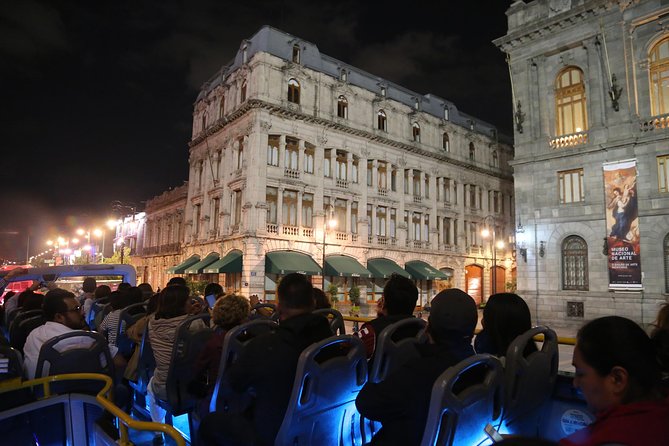
This Turibus ride is best understood as a city sampler. You sit back, look up, and watch Mexico City pass by in lights. It is not a detailed historical tour, and it does not stop for long visits at each sight. Instead, it gives you a fast look at the central districts and the main ceremonial avenue.
The price makes the tour easy to recommend as a first-night option. At $10 per person, you are paying less than many guided walks, while avoiding a fair amount of walking. You can see the city’s major monuments, hear basic background information, and decide which places deserve a closer visit the next day.
The ride lasts approximately 45 minutes according to the tour details. Actual timing may vary. Traffic, demonstrations, holiday crowds, street celebrations, and road closures have all affected departure times and route length. Some rides have felt closer to 30 or 35 minutes, while heavy traffic has made others run longer than an hour.
That unpredictability matters in Mexico City. Reforma is a major public avenue used for concerts, marches, protests, civic events, and celebrations. A nighttime ride during Día de Muertos, Christmas, or another city event may bring extra atmosphere, but it may also bring a slow crawl or a changed meeting point.
More Night Bus Tours in the world:
- Dubai: City Sightseeing HOHO Bus Tour + Sunset & Night Tour
★ 4.3 · 6,442 reviews - London: London by Night Sightseeing Open-Top Bus Tour
★ 4.5 · 5,516 reviews - Paris: Big Bus Panoramic Night Tour by Open-Top Bus
★ 4.4 · 4,168 reviews
Starting at the Zócalo after dark
The meeting point is Turibus Tours on Calle de Monte de Piedad, beside the Zócalo in the Centro Histórico. You start in one of the most impressive urban spaces in the Americas, even if you only have a few minutes before boarding.
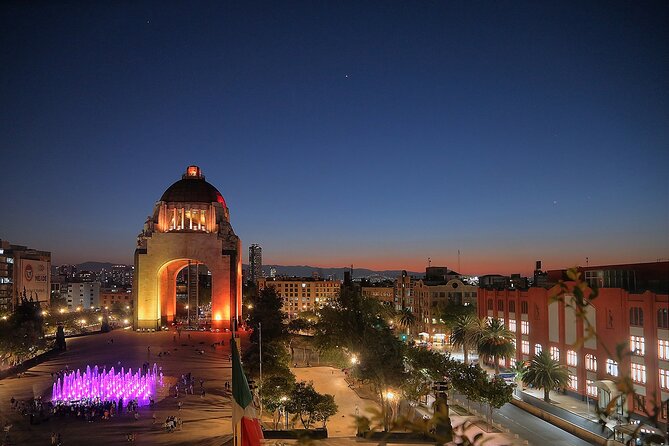
The Zócalo is formally known as Plaza de la Constitución. It is framed by the Metropolitan Cathedral, Palacio Nacional, the former Government Palace, and the Government Building. A huge Mexican flag flies in the middle of the plaza, giving the square a strong national feel.
The setting is a good reason to arrive early. You can take in the cathedral and government buildings before boarding, but the area can become crowded, especially around holidays and public events. The departure point is near public transportation, though you must arrange your own way there. Hotel pickup and return transportation are not included.
Show your mobile ticket at boarding. The service allows mobile tickets, and confirmation is provided when you book. The group size is limited to 30 people, though the exact bus and seating arrangement can affect how quickly everyone boards.
The bus returns to the same meeting point. Do not treat this as a ride to another neighborhood or a hotel drop-off service. It is a loop-style sightseeing trip, and it is not a hop-on hop-off tour.
Reforma, Mexico City’s grand ceremonial avenue
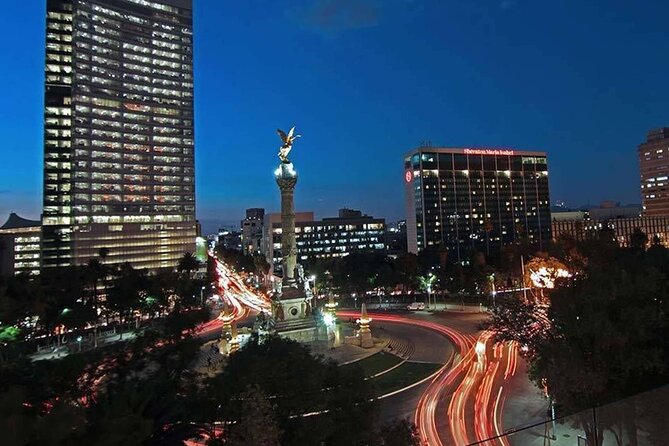
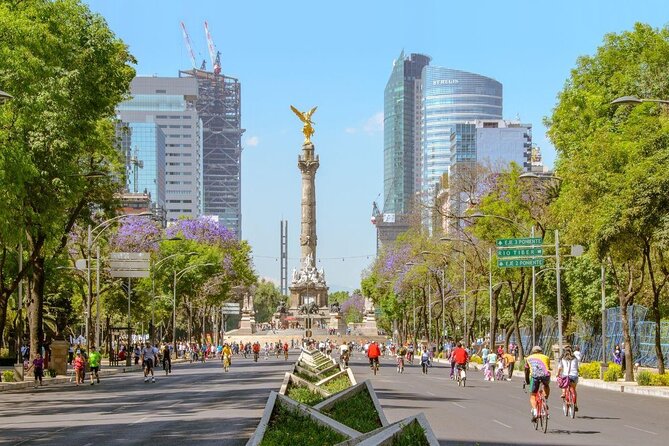
The most important part of the ride is the passage along Paseo de la Reforma. This is Mexico City’s broad, symbolic avenue, lined with monuments and used for everything from public celebrations to large demonstrations.
From the upper deck, you get a useful sense of the avenue’s scale. The bus gives you a moving view of traffic, pedestrians, illuminated buildings, and monuments rather than a single fixed lookout. At night, the street lights and passing city activity add much of the appeal.
Reforma is also where timing becomes hard to predict. A slow-moving bus can be helpful for photographs, since you have more time to frame a monument. It can also become frustrating when traffic is nearly stopped. Some rides have spent much of their time in congestion, which makes the fixed route feel shorter than it looks on paper.
I would choose this tour for the atmosphere rather than perfect efficiency. If you want a carefully paced history lesson with long stops, this is not the right format. If you want to watch one of Mexico City’s main avenues after sunset and get a broad first impression, it does the job well.
The modern three-tower complex
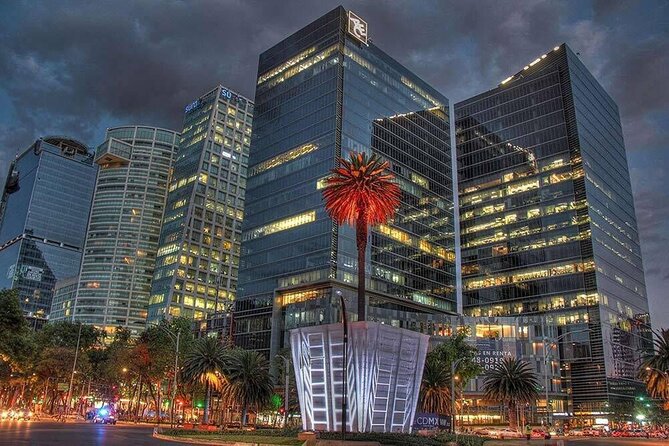
The route also passes a modern complex made up of three towers. These buildings are among the tallest in Mexico City and changed the look of the city skyline when they were built. Their sharp contemporary design offers a contrast to the cathedral, colonial government buildings, and neoclassical monuments elsewhere on the route.
The complex includes a shopping center and movie theaters. The ride does not provide a long stop for shopping or sightseeing there, so think of it as a passing architectural highlight. From the upper deck, you can compare the older civic center with the newer commercial side of the city.
This is one of the useful features of a panoramic bus ride. You see more than famous monuments. You also notice how Mexico City combines historic public buildings, modern towers, commercial centers, and crowded avenues within a relatively short route.
More night tours around the world:
- Prague: 50-Minute Sightseeing Evening Cruise
★ 4.2 · 33,780 reviews - Amsterdam: Evening Cruise with Optional Wine and Snacks
★ 4.4 · 22,178 reviews - Budapest: By Night Sightseeing Cruise with Welcome Drink
★ 4.3 · 15,533 reviews - Paris: Illuminations River Cruise with Audio Commentary
★ 4.3 · 12,340 reviews
The Independence Monument lit up at night
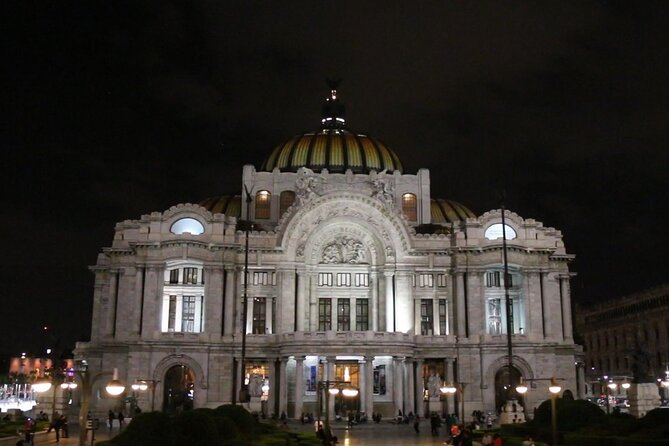
One of the key sights is the monument inaugurated in 1910 to mark the 100th anniversary of Mexican Independence. It serves as a mausoleum for heroes of the independence struggle and has become one of the city’s best-known symbols.
At night, lighting gives the monument a different character than it has during the day. You may have only a brief passing view, but the elevated bus deck helps you look over traffic and surrounding vehicles. The slow movement of the bus can also make it easier to take photographs than you might expect.
The tour commentary should provide basic context about the monument and its role in Mexican civic life. Still, keep your expectations in check. The narration is an audio presentation, not a personal guide standing beside you and responding to questions. Some passengers find the information useful and entertaining, while others find the script too general.
If this monument interests you, make a note to return during daylight. The bus gives you a preview, not enough time to examine the sculpture, surrounding avenue, or nearby buildings closely.
The Benito Juárez monument
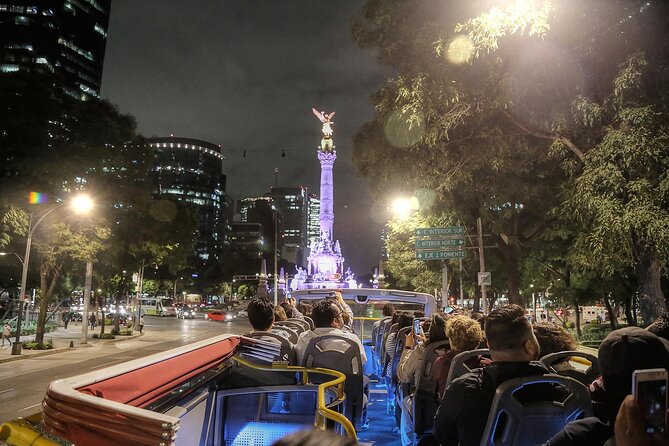
Another stop on the route is a monument honoring Benito Juárez, one of Mexico’s former presidents. It uses a neoclassical design with 12 marble Doric columns, which look especially striking when illuminated.
This is a good example of a sight that is easy to miss when walking or riding in a regular car. From the upper deck, you get a raised view of the columns and lighting. The audio adds a short introduction, helping you understand why Juárez remains such an important figure in Mexican public life.
Again, the bus does not function like a museum visit. You will not get off to inspect the marble or read detailed plaques. The value is in seeing the monument in its larger city setting, alongside the avenue and nearby traffic.
The upper deck is the main attraction
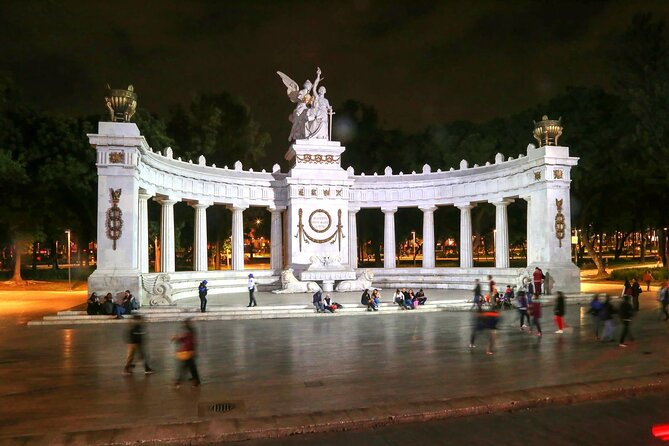
The best reason to book this ride is the view from above. From the upper deck, you can see over cars, catch clearer sightlines to monuments, and take photographs without being boxed in by street-level traffic.
The open-air seating comes with tradeoffs. Mexico City evenings can feel chilly, and the wind is stronger once the bus is moving. Bring a warm layer even if the afternoon was mild. Rain can also change the experience quickly. One passenger continued in heavy rain with a poncho, but conditions like that can make the upper deck uncomfortable and may limit your photographs.
Low-hanging electrical cables have also raised safety concerns on some routes. Pay attention to staff instructions and avoid standing or leaning over the side. The upper deck is valuable for the view, but it is not a place to ignore overhead hazards.
If the upper deck is full, you may still see the major sights from below, but the experience loses much of its panoramic quality. Arriving early gives you a better chance of choosing a seat upstairs, though seating depends on the bus and crowd at that departure.
How the multilingual audio really works
The bus uses Spanish narration over the vehicle’s speakers. English, Spanish, and French audio are also offered through earphones connected at individual seats. This distinction is important.
Ask the staff for earphones before the bus leaves, even if nobody offers them immediately. Test the connection while you are still at the meeting point. The audio controls are intended to let you change channels and adjust volume.
This arrangement has caused repeated confusion. Some passengers have boarded expecting the whole bus to operate in English, only to hear Spanish over the loudspeakers. Others have received earphones but could not hear the English program because the Spanish speaker volume was too high. Faulty seat outlets have also been reported.
I would not book this as an English-language history tour without allowing for that risk. The English option is part of the service, but the practical experience depends on working equipment and clear instructions from the staff. If the audio fails, your main experience becomes the scenery, traffic, and city sounds.
The commentary itself is recorded rather than personalized. That is fine if you want a basic orientation, but it will feel thin compared with a private guide who can answer questions or adjust the explanation to your interests.
Traffic, celebrations, and route changes
Mexico City traffic is not a minor detail here. It can shape the entire ride. Reforma is used for large public events, and the central streets around the Zócalo may be closed for demonstrations, festivals, Día de Muertos activities, or other celebrations.
Traffic can create two opposite problems. A slow ride may give you extra time to photograph a monument, but it can also mean sitting in the same area for much of the tour. A changed route may protect the schedule or safety, but it can reduce the number of sights you see.
On rare occasions, street closures have forced a departure point to change or an activity to be canceled. Communication during those situations has not always been fast. Check the meeting information before leaving your hotel, especially during major city events, and keep your plans flexible.
The operator offers free cancellation up to 24 hours before the start time. Cancellations or changes within 24 hours are not refunded, so the tour is best booked when your evening plan is reasonably settled.
Who gets good value from this $10 ride?
I see three strong uses for this tour.
First, it works well on your first night in Mexico City. You get a broad look at the historic center, Reforma, major monuments, and modern towers without committing to a long walking route. It can help you decide where to return during daylight.
Second, it suits families and visitors with limited energy. The ride lasts less than an hour in normal conditions, and you can see a long list of landmarks while seated. The price also keeps the risk low if the weather turns or the audio proves disappointing.
Third, it is a good choice for people who enjoy city lights and street scenes more than detailed interpretation. The view from the upper deck, the sound of traffic, and the passing crowds create a sense of Mexico City at night that a museum visit cannot provide.
I would skip it if you already have a private city tour, need exact timing, or want to get off at each landmark. I would also think twice if a reliable English narration is essential. The $10 price is fair for a scenic orientation ride, but it does not buy a polished, fully controlled sightseeing experience.
Should you book the Mexico City night bus?
Book it if you want an inexpensive first look at central Mexico City, especially from the upper deck. The Zócalo, Reforma, the Independence Monument, the Benito Juárez monument, and the modern towers give you a good mix of old and new city views.
Arrive early, dress warmly, ask for English earphones, and test the audio before departure. Keep extra time in your evening schedule because traffic and public events can change the ride.
For $10, I think the tour is worth considering as a quick orientation and photo ride. Just do not confuse it with a detailed guided tour or dependable city transportation. Its strengths are the price, the elevated view, and the amount of ground covered. Its weak points are traffic, inconsistent audio, and limited control over the route.
FAQ
Where does the night tour begin?
The tour begins at Turibus Tours on Calle de Monte de Piedad in the Centro Histórico, beside the Zócalo in Mexico City.
What time does the bus leave?
The scheduled start time is 7:30 pm.
How long does the ride last?
The advertised duration is approximately 45 minutes. Actual timing can vary because of traffic, celebrations, demonstrations, and street closures.
Is the tour available in English?
English audio is offered through earphones. Spanish narration is played over the bus speakers, and French audio is also available through the audio system.
Does the bus return to the starting point?
Yes. The activity ends back at the original meeting point in the Zócalo area.
Is this a hop-on hop-off bus?
No. This is a continuous sightseeing ride, and hop-on hop-off service is not included.
Just added for nights around the world
- Ubud Day Tour : Waterfall, Temple and Local Night Market Tour★ 5.0 · 17 reviews
- Bali Food Tour: Savor Street Food and Night Market Adventures★ 5.0 · 46 reviews
- Eat like a Local: Venice Cicchetti and Wine Tasting Evening Tour★ 5.0 · 122 reviews
- Venice by Night: Highlights & Hidden Gems Tour★ 5.0 · 128 reviews
- Venice Evening Food Tour: Bites, Drinks & Sit-Down Dinner★ 4.5 · 83 reviews
- Ubud: Village Firefly Night Tour with Dinner★ 4.9 · 23 reviews
- Evening Walking Tour with optional motorboat Ride★ 4.2 · 225 reviews
- Ubud Traditional Night Market Food Tour-All Inclusive★ 4.4 · 95 reviews
Mexico City Night Tours, compared.

Browse the lists this tour appears in